Showing posts with label Hymers clan. Show all posts

Thursday, March 1, 2012

March 1 - John George Hymers

My great-great grandfather, John George Hymers was born on March 1, 1859 in Blenheim, Burford, Ontario, Canada.  He was the son of Francis Wilson Hymers and Elizabeth Rankin Morton. He grew up in Canada, eventually moving to Minnesota.  The 1880 Polk Directory had him living with his older brother Thomas, in a boarding house at 360 Rice Street, St. Paul, Minnesota.  He returned to marry his school sweetheart, Rozilla Kipp on February 21, 1882.  
They returned to St. Paul, Minnesota where John eventually found work as a fireman/driver for the St Paul Fire Department. The 1889 St Paul Directory lists John Hymers as a fireman/driver for Chemical #5.  He and Rozilla were living at 887 Randolph, St Paul, from 1889-1892, and then their name does not appear again until 1898, when the address is given as 801 Hall Avenue.  For most of their married life, they lived at 50 W. Belvidere in St Paul.  (excerpt from Lois Glewwe research 1980's).   In earlier posts, I wrote about my grandmother and her childhhood on the Kinkaid prairie.  She wrote about her memories of her grandfather John and how he helped them build their sod house and survive through the cold winters and very little comforts.  John and Rozilla had 7 children, 6 who lived into adulthood.
Happy 153rd Birthday!

Friday, October 14, 2011

In Her Own Words - Aug 1916

     "Mama was a dressmaker and when she brought her sewing machine back from St. Paul it wasn't long before the women of the town and country contacted her to sew for them.  After the fall harvesting was over, Mama and I would go to town for about a week.  We would stay at Mrs. Williams, they had a big house.  I loved to go there -  they had four daughters.  Hazel was older than me, Violet was my age, Myrtle and Inez were younger but we all played together.  I always looked forward to these wonderful times.  Mama would sew for Mrs. Promery, the judge's wife, and Mrs. Lee who taught piano, her husband was the register of deeds.  Mrs. Haddad was from New York and she was very stylish.  Once she gave me some taffeta material for my doll, but Mama made a ribbon for my hair.  Mrs. Menzie had a daughter and when I played with her we always got ice cream, they had the drug store and ice cream parlour.  Mama sewed for everyone.  Hazel, Violet and I were very good friends.  Hazel and Violet used to send for sample products.  I suppose they had access to products because of their father's general store.  It was a wonderful thing to receive little sample bottles of cologne, powder, sachet and various food products.  The girls would give me their duplicates.  Mama would be paid for her work and it meant a lot to Mama.  Papa said that was her own money and she could spend it on anything she wanted.  We had just returned from town that year.  It was dinnertime and Papa, Mama and Grandpa and I were just finishing the noon meal when we got a telephone call for Mama.  It was Mrs. Cassel.  They had just received a telegram for Mama from St. Paul, Minnesota.  Mama's brother Frank had died.  He had been sick but was much better and Mama had decided she wouldn't go home to St. Paul that year.  I remember Papa saying we can get you to town for the morning train and Grandpa said, "What are you going to use for money?"  The finances were combined into one account and Grandpa had used quite a sum to send Grandma and his family back home to St. Paul.  Mama reminded Grandpa of the money she had earned sewing and he remarked that he thought it wasn't necessary for her to make the trip, but Papa said Lena (Mama) and Ethel were going.  So we left for St. Paul to attend the funeral of my mother's older brother, Frank.  We stayed until March.  It would be three years before we visited St. Paul again."

The above story is a continuation of memoirs written by Ethel Hymers Glewwe on her childhood in Saskatchewan, Canada.

October Ten or more Lists - Babies Week 3

Being the mother of five children, I am always amazed when I think back on the mothers of earlier generations who had more children, a LOT MORE children!  I think of how small their houses were, how they did not have indoor plumbing or electricity and all of the entertainment that came from these.  Sure they had books, and my family certainly has many a bookshelf overflowing with the printed word, but still.  All those mouths to feed three times a day, the laundry, even just combing of long hair!  Mothers were certainly saints in my view.

This week I present the next great woman from my family tree who bore many children. Eleven for sure, although some published trees put this number at 12.  But I think she would have been too old for this folly.

My paternal GGGG grandmother Elizabeth Force married Benjamin Kipp when she was 18 years old,  on 20 April 1836 in Burford, Canada.  Within eleven months she gave birth to my GGG grandfather, Hamilton Kipp.  And so I present the Kipps

Hamilton (1837 - 1885)
Isaac (1839 - 1921)
Disree (1840 - 1849)
Henry (1842 - 1930)
Elizabeth Ann (1845 - 1875)
Melissa Jane (1847 - 1929)
Alfred (1849 - 1940)
William ( 1851 - 1852)
Mahlon Taylor (1853 -       )
Cadelia Louisa (1858 - 1918)
William Henry (1862 - 1921)

For those in my family who wonder where this name comes in
Hamilton Kipp married Orilla Lewis.
Their oldest daughter, Rozilla Kipp married John George Hymers,
Their son Francis George Hymers married Caroline "Lena" Nascher
and "now you know the rest of the story".

If I follow others work on the Kipp family they trace the name all the way back to the 1500's to a Ruloff De Kype in Holland/France.  (But as I read more genealogy blogs and footnotes of research done and making sure that what I quote is accurate, I stop much earlier in my claim.)

Tuesday, September 13, 2011

In Her Own Words - The New House

These are some of the memoirs written by Ethel Hymers Glewwe on her childhood in Saskatchewan, Canada from 1910-1918.

Building a New House - 1913-1915

     " Papa always planned on building a new house for us - so while Mama and me spent the winter of 1913 in St. Paul, he worked hard getting the grain hauled to town and using the money he made for selling the grain to buy lumber and building supplies.  the he hauled it to the farm and stored it in piles to ready when the time came that he could call on his cousins and neighbors for help.  He dug out the cellar under the kitchen of our house and erected support posts under the house.  The sod on the outside had to be removed, so he took it off about half way down.  Winter set in, but it was rather a mild winter and he was able to mark out and lay a foundation of stones for the addition.  Grandpa and our neighbor,  Joe Rands, helped.  Grandpa said he always did the cooking.
   
    Mama and I came home from St. Paul in March, 1914, and from then on it was a very busy year.  I remember Mama and me hauling away the sod off the house and putting it into a dry well hole that the well diggers had left when Papa was trying to reach some drinking water in our farmyard.  Usually the farmers began planting wheat early in April and when not planting, other ground was worked  over to plant in May - the corn and finally on Queen Victoria's birthday - potatoes and garden vegetables.  By June the crops were growing and there was a slackening of farm work and time for a house raising.

     Papa's cousins, Bert and Bud, Joe Rands and even the men and their wives from town came.  Some brought their children.  They moved most of the furniture outside and some into the granary that Papa and Joe had built.    Everyone had something to do - the ladies that came helped Mama cook the meals and many brought food and we all shared.  It took about three days to get the walls up and the roof closed in, before it rained and I can remember the night it rained.  Papa had moved our bed back in, but the roof leaked and we got wet and Papa put a canvas over us like a tent.  I thought it was fun, Mama was worried about all their work being ruined - Papa always made an adventure out of a catastrophe.  Finally the house was finished and Mama was very happy.  We had three bedrooms upstairs and two big clothes closets, a large living room and the old kitchen.  A cellar door and stairway was built under the stairway that went upstairs - it was such a nice house - a permanent wall was built to close in the pantry and a heater stove was installed in the living room.,  From this stove a pipe was extended to the bedroom upstairs and a pipe  from the cooking stove in the kitchen heated one of the bedrooms above the kitchen.   One bedroom had no heating pipe, but it wasn't much different that the one with the pipe.  I remember the upstairs was always cold in the wintertime.

     Grandpa wanted Grandma and their daughter Cora and son Allan to join him and hopefully stay.  But Cora was just graduating from high school and she had a group of piano students she was teaching and she didn't want to come.  Grandma and Allan came and Grandma brought some furniture, but she didn't like the house that Grandpa had on his section of land so they moved into our house and Grandma and Grandpa slept downstairs in the living room in their own bed and Allan slept upstairs in one room and I slept in the other room and Mama and Papa slept in the front bedroom upstairs that had the big closet.  Mama said it was wonderful to have so much room.

     Mama put in a big garden, Papa plowed about an acre - and I remember helping her with the measuring line and dropping beans and peas into the ditches she made with the hoe.  Grandma helped with the cooking, she could bake the best bread and cookies she called oatmeal rocks.  Mama did a lot of vegetable canning and usually when the harvest was over she had rows and rows of jars full of peas, beans, and carrots.  We had citron preserves and later on we had raspberries and strawberries that we grew.  We had pickles too and sauerkraut.  We considered ourselves very fortunate and one of the more prosperous farmers.  Grandma had a brother named Charles Kipp and he lived in Oregon.  His wife died and he wanted to visit his sister in Saskatchewan and his sister in St. Paul - so he came to visit.  I liked Uncle Charlie.  When Uncle Charlie was ready to leave for St. Paul, Allan went back with him.  Allan had to go to school and Grandma was persuaded to stay the winter of 1914-1915."

Sunday, September 11, 2011

In Her Own Words - The Livestock and Such

Another chapter in the memoirs of Ethel Hymers Glewwe, and her childhood growing up in Saskatchewan, Canada - 1910-1918


     "I don't remember too much about building the barn except Papa wanted to have a name for his farm and when he had been working on the telephone lines he had found some antelope or deer antlers, so he chose Deer Horn Ranch.   He nailed the deer horns on the wall in the peak of the roof and they remained there for many years.  The barn wasn't very big and a few years later he had to build a bigger one but this one was much better than the sod barn.  We kept the cows in the sod barn for a while, and then they finally moved into a lean-to that Papa put on the barn.


We had four teams of horses in the barn and I can remember their names.  King and Dock, the team from the fire department, and Jack and Bell, Jim and Dolly and Dan and Clair.  We had single horses for the buggy and riding.


Mama with Dock, King, Bell and Dan


    My horse's name was Prince.  He had a white face and was a trained cow pony.  Then we had Kit, a beautiful dapple grey and high-stepping Fly.  Nugget was a bronco and if you weren't careful, would buck you off.  We also had Maud, Jenny and Lady.  Maud and Jenny we bred and let run with their colts.  Lady was a pacer and Papa had bought her from a racing horse stable.  Allen always rode her to school.  She always wanted to race, and when I rode to school on my pony, Prince, we often raced the half mile to the crossroads on our way home from school.


    We had names for the cows also.  There was white-faced Daisy and black-faced Daisy, then Sutton who belonged to a farmer named Sutton who died and his widow gave us the cow when she left the farm.  There was Bessie, Nancy, Patsy, and my cow's name was Bertha.  I have my picture taken with it when it was a calf.  It was our first calf and Grandpa said it was a girl so he would name it after his first daughter. (I wonder if my Aunt Bertha ever knew we had a cow named after her?)


     We had some pigs but we only named the mama pig.  She was Sally and she had a lot of little pigs every year.  Sally was very tame and if we was alone in the pen Papa would put me on her back and I'd hold onto her ears. She would give me a ride all around the pen.  I used to scratch her behind the ears.  She would come over to the fence and wait for me.


     We had some white turkeys.  Turkeys are a very difficult type of fowl to raise.  They keep close together in a flock and sometimes become attached to a leader gobbler, who might decide to leave the protection of the farm yard for a hollow in a field or a dry creek bed.  This was dangerous to their safety.  At night they would huddle together with no protection from the prowling wolves or coyotes.  You can't drive turkeys - they just won't go where you want them to.  Once Papa had to search them out and it was a good thing they were white because Mama, Papa and I sneaked up on them and caught them and put them in sacks.  Some got away but we got the gobbler and the next morning the stragglers had come back home.  Papa cut their wings so they couldn't fly away and we had to put up a fence to keep them home.  Mama didn't raise many turkeys after that.  We had ducks and geese but Mama didn't like them.  They were such dirty fowl.  They always tried to bathe in their drinking water.  We couldn't waste so much water.  Mama had to make a special drinking pan just for the ducks.  They didn't wander away, they stayed in the farm yard.  I didn't like the geese and the old gander always wanted to chase me and he'd scare me.  Mama always canned chicken and turkey, but we sold the geese and ducks in town at Williams' Store.  Sometimes Papa would shoot rabbits and Mama canned them too.  We always had some kind of meat over the winter, later we even smoked meat when we butchered a pig."

Friday, September 9, 2011

In Her Own Words - Kincaid

     "It was in the spring of this year that the railroads began to move into the Providences. Tracks were laid about 12 miles north of our farm. Grain elevators owned by the railways were built and the post office was moved to this new location, Kincaid. It wasn't long before the tradesmen and businesses came in.


     There was Alfred Williams General Store, Menzies Drug and Ice Cream Parlour, Haddad Hotel, Mortuary and Furniture Store, Joe Frosted's Lumber and Implements and Percy Ross's Garage and Wagon shop. There was Wong's Restaurant and Promery and Lee's Law and Insurance Office.


     Then the telephone came and Mrs. Cassel was the telephone operator. Marion Cassel was a very good friend of Papa's sister, Cora. The post office was in the general store with Alfred Williams as postmaster. Pierre Jacques was the station master. Alfred Williams had two brothers, Tom and Joe. Joe ran the grain elevator and a livery stable. Tom had a farm east of town.


     These town people were all very good friends of my parents and we often visited back and forth during the years of my childhood. Papa was president of the telephone company and he organized a crew of farmers to build and extend the telephone lines as far out as our farm and some distance south of us. He and the crew would dig pole holes and put up wires for days at a time and even stayed overnight at different farmers' houses when he was too far away to come home.

     There was a big celebration when the line was complete. Farmers came from miles away to Kincaid to show their support. This was a wonderful thing to be able to telephone town and to contact each other. We probably were one of the first to have a telephone. Our ring was two long, one short. There were fourteen on the line. If too many families listened in one couldn't hear very well. The story goes that Grandpa was talking on the phone and a neighbor was listening and Grandpa said over the phone if 'that nosy Corcoran would get off the phone and mind his own business may he (Grandpa) could hear better'. Mr. Corcoran was supposed to have said, 'I'm not listening!'"

More words from the memoirs of Ethel Hymers Glewwe.

Thursday, September 8, 2011

In Her Own Words - 1913

     "Grandpa returned from St. Paul early that spring.  He was anxious to build a small house on his property so he could bring Grandma from St. Paul and his young children.  Grandpa's first house was like a double barn or granary.  It faced east and the door was in the middle.  On the south end was the kitchen and living room - it was one room.  On the north end of the building were the bedrooms divided by a curtain on a wire strung across the room.  There was a window on the north and west for the bedrooms and one on the south for the kitchen.


  I remember when Grandma came she didn't like it very much and didn't want to unpack her suitcase.  Mama convinced her that it wasn't too bad when the garden grew with all the fresh vegetables and the chickens began laying eggs.  We would have fresh eggs and milk with thick cream and butter and home-baked bread.  The days would go by fast enough before she would have to return to St. Paul.  Grandma didn't come though until after my Papa's sister, Cora and brother, Allan, were out of school.


     I don't know where everyone slept, but I remember I did sleep sometimes with my Aunt Cora.  That spring must have been awfully busy.  I can remember Mama and me going in the horse and buggy over to Grandpa's house with lunch for him while he worked on his house and I remember cleaning windows.  Because I wasn't tall enough to reach them from the outside, Mama got me something to stand on.  That spring Mr. and Mrs. Britton came from Ontario and joined their bachelor sons, Bill and Bob.  They lived across the road from Grandpa's where Grandpa's first house or sod hut was.  Mrs. Britton was older than Mama and she showed Mama how to cure meat and preserve eggs and dry vegetables for winter.  I liked Mrs. Britton and I often visited her.  She could sing and taught me a song about a dog named Rover.  Later on their three daughters joined them, Lottie, Mae and Jean.  They were grown-ups.  Lottie went to Moose Jaw to work in a hospital.  I think she was a practical nurse.  Mae helped her mother on the farm and Jean was a school teacher.  They had been educated in Ontario.  Mama was glad to have other women as her neighbors so close by.


 Grandma, Cora and Allan came in late June, 1913, and in August, Ethel came.  She was engaged to be married and wanted to see Papa, her brother, before she got married.  She was a lot of fun and while she was visiting us she learned how to ride a horse.  She went back to St. Paul with Grandma, Cora and Allan in September.  Grandpa stayed on the farm to help Papa.


     Papa wanted to build a barn for the stock and get rid of the old one with the straw roof and sod walls, so he brought lumber home with him when he hauled in the threshed wheat.  We didn't thresh our wheat on our farm the first few years.  We hauled the cut wheat straw to Papa's cousin Bert's farm to be threshed.  Later on we hired a threshing crew and Papa even worked for the man who owned the machinery."


Frank Hymers

Another chapter in the memoirs of Ethel Hymers Glewwe, and her childhood growing up in Saskatchewan, Canada - 1910-1918

Wednesday, September 7, 2011

Wordless Wednesday - Kinkaid, Sasatchewan

About 1915

For the past month, I shared the memoirs written by Ethel Hymers Glewwe of her childhood homesteading in Kinkaid, Canada.  Today, Wordless Wednesday I share pictures of this land.

1995

Not much has changed!

Thursday, September 1, 2011

In Her Own Words - Our Neighbors

This excerpt is a continuation of the memoirs written by Ethel Hymers Glewwe on her childhood in Saskatchewan, Canada from 1910-1918.

     "My papa was a big man, 6 feet 1 inch tall and weighed about 210 pounds.  He could lift me up to his shoulder with one hand and I'd put my arms around his neck.  Sometimes he pretended he was a horse and get down on his hands and knees and I'd climb on his back.  Sometimes he would hide behind the stove and pretend he was a wolf and I'd run to Mama.  I remember after he took care of the stock at night, he would come in, take off his big shoes and pull up a chair facing the stove.  He would open the oven door and put his feet on it and I'd crawl up on his lap and he would tell me stories until I'd fall asleep.  Then he's lay me in my trundle bed.  I remember once I got sick and I couldn't go play in the snow.  Mama sat me by the window and Papa and Mama made a snowman for me and Papa put a corn cob pipe in the snowman's mouth and he had a straw hat.  My snowman stayed a long time.

     Our bachelor neighbors loved within snowshoe distance.  Mr. Beckmann lived about 2 miles east of our farm.  He was, Grandpa said, a man of letters.  I didn't know what Grandpa meant until a few years later when Mr. Beckmann asked Papa to store his trunk for him.  He was going back to England for a visit and would be back in a year.  But he never returned and we opened the trunk and found many text books on many subjects, so we surmised he was a teacher or professor in England.  There was no address or identification to where we might send the trunk and so we just kept it and the books.  Mr. Beckmann had a dog - his name was Shot - and he gave Shot to me.  He was a big, brown, curly-haired water spaniel.  I could climb on his back, but he made such a nuisance of himself in the water troughs for the horses and cattle.  Papa said he had to go so he took him to town.  This was when the town was closer to our farm.  Papa gave him to the station master.

     Then we had Mr. Lilly.  He lived just south of our farm and sometimes you could see smoke coming from his chimney on his house.  He would come over once a week and Mama baked bread for him and cut hos hair.  He liked Mama and me and would bring his banjo and play and sing for us and sometimes Papa would get out his violin and then we would enjoy singing the old songs.  Mr. Lilly could play anything and Papa said that he thought Mr. Lilly must have been a music man. 

     Joe Rands only lived a mile away and he was a relative of Papa's through marriage.  He was married to a daughter who was adopted by the brother of my Papa's Uncle Jim.  She had died and left Joe with a four-year-old son whom he left with his mother in Ontario when he came west to homestead.  My Papa and Joe were very good friends and he helped Papa and Mama very much.

     Just north of our farm were Papa's cousins - Bert and Bud Crozier.  They lived about a mile as the crow flies - just over the hill.  You couldn't wee their house like we could see Joe's.  Grandpa's farm was straight west and only one half mile and if he was outside you could see what he was up doing. 
When Mr. Beckmann and Mr. Lilly and Joe would come over to our house in the afternoon, Papa would have them stay for supper an then they would get around the table and play Five Hundred.  I would first climb on some one's knee and then another until I'd get tired and Mama would put me to bed.  Sometimes the men would just visit or if Mr. Beckmann brought his mouth organ he would play it for us.  I can't remember ever being lonely."

Monday, August 22, 2011

The Nascher Family

Lois Glewwe, when writing the Glewwe Family History book also wrote a short booklet about the Nascher family.  What follows is an excerpt from that paper.


   "Frank J Nascher and Ursula Marie Marxer, known as Mary Marxer, were both born in what was then Lichtenstein County, Germany.  Mary was born in the village of Furstenthur on May 3, 1863; Frank was born on February 10, 1859, presumably in the same village.  According to family stories, Mary met Frank at a village festival.  She knew he was from "up on the hill," and therefore someone important in the village.  There was an unwritten rule at that time that you could not go courting on Friday nights; if you did, it would be an insult to the young lady.  Thus, Frank J Nascher, who had been given the strictest orders not to associate with the peasant girls from the village, was nevertheless watched closely, except on Friday night, when it was certain he wouldn't attempt to speak to a young lady.
  One afternoon, however, Mary was in the barn feeding the chickens when Frank came around the corner of the shed.  She said that at first she was very angry with him, but he told her that he loved her and just had to see her.  They began to meet secretly on Fridays and their love grew.  When Frank told his uncle, who was governor of the village at the time, that he wanted to marry Mary, he was disinherited.  Despite these efforts to end the romance, Frank and Mary were married on May 6, 1882.  They left a few months later for Minnesota, where Mary's oldest brother, Joseph Marxer had settled."

Thursday, August 18, 2011

In Her Own Words - 1912-1913 Our First Winter as a Family in Our Very Own Home

      "It had been a good year - there was enough grain for spring seeding, the oats were sufficient for feeding the stock, the flax had long straw and provided fresh filling for the mattresses and plenty to burn in the stove for heat and cooking.  A new roof was on the house and a ceiling made space for storage and insulation from the cold winds.  The walls were covered with wood and looked so nice, better by far than the dirty looking tar paper and everything was freshly painted.  Most of the bachelor neighbors would be staying over winter on their land, while some of the married ones had gone back to their home base to bring back their women folk and children in the spring.  Everything was exciting and full of hope.  The winter would pass quickly - so much to plan and prepare for.   Grandpa left around the first of December.  I was 2 1/2  years old and Mama said that before Grandpa left he told me that when he got back in the spring he wanted me talking - for some reason or other I wouldn't talk very clearly and he was always coaching me.  But Mama said that right after Papa left to take Grandpa to the train, I was talking away and after that Grandpa had a hard time keeping me quiet.  They relate the story that when he came back he had brought some fresh peaches and I wouldn't be quieted unless I got a peach.  Grandpa told me if I sat still and didn't talk for an hour I could have a peach.  I did and I got the peach.  To this day peaches are my favorite fruit.
      Mama told me that when Papa and Grandpa had left for the train station it was a snowy, cold day and Papa had told Mama what to do while he was gone.  Mama could take care of me and the chickens, but keeping the fire burning in the stove was something else.  Flax straw for fuel was in bags just outside the door and the water was in a barrel in the house.  Papa's cousin would come every morning and night to take care of the stock.  There was nothing to fear but Mama was apprehensive and although she never let on to Papa, she was scared to be all alone with only me.  The first night it snowed quite hard and drifted around the door.  She hadn't really tried to open it before Papa's cousin came and dug her out, fed the chickens and stock, and told her if it snowed any harder she shouldn't attempt to go out.  The stock would be okay and he would come back on snowshoes.  He returned later in the day and brought a long rope with him.  Mama said she wondered what the rope was for, but when she saw him attach it to the side of the barn door and then over to the chicken shed and then on the pole for the wash line and then around the water barrel and then onto the house door jamb, she knew this wasn't just a snowfall.  When he was through he came in and told her she must stay in the house because this was a bad blizzard.  He assured her that the barn door was shut tight, the stock had plenty of straw and the chickens would huddle together.  If she should hear or see coyotes on the barn roof, not to worry.  He was sure they couldn't get in the barns - the rafters were close together to hold straw and there was tar paper between.  It would take a while for the coyote to work his way through and if it was real snowy they wouldn't hang around - they would find a straw stack.
      That night Mama said she didn't sleep, she could hear the wind blowing around the house and it seemed to blow right through the house.  The lamp would flicker and almost go out, but she kept it burning.  The she heard the howling of the coyotes or was it wolves.  There seemed to be more than one.  She remembered that Papa had said coyotes usually ran in pairs but wolves ran in packs.  She wondered if the chickens were frightened and she tried to see out the east window to the barn, but she couldn't see through the swirling snow.  The night became more threatening until she couldn't overcome her fears any longer and woke me up and kept me awake so she could talk to someone. 
      At last daylight came and the wind was quiet.  In the morning it had stopped snowing and sun danced on the new, white snow.  It was as beautiful a sight as one could ever hope to see.  Mama said the snow covered the straw roofs and hung over the sides like frosting on a cake.  She was glad that Papa's cousin had strung the rope form the barn to the house.  It was much easier to reach the barn with the rope as a guide.  After that, Papa always had the rope handy in case of a snow storm.  Many stories have been told about folk who did not prepare for a snow storm and lost their way in their own farm yard and some even froze to death."


(A continuation of the memoirs written by Ethel Hymers Glewwe about her childhood in Saskatchewan 1910-1918)

Wednesday, August 17, 2011

In Her Own Words - A Trip Home 1911

This is a continuation of the memoirs written by Ethel Hymers Glewwe of her childhood in Saskatchewan in 1910 - 1918.

       "The fall of 1911 came and it was decided that Papa would stay in Canada over the winter while Grandpa and Mama and I would return to St. Paul, Minnesota. It was necessary for someone to remain on the farm. The mare horse that we had bought from Papa's Uncle Jim's was in foal and couldn't be left alone. She was due in early spring, and Papa wanted to put a wooden roof on the house with wood on the walls and paint the walls, so he had plenty to do, along with feeding the chickens and stock. Grandpa wanted to go back to St. Paul. He hadn't been home for over a year and he missed Grandma and his family, and then he had heard that the fire department was selling the horses that he had driven as a team on the water wagon. He needed horses to break the ground, oxen were very slow and sometimes temperamental. We also needed farm equipment and Grandpa felt he could find better buys in the U.S."

(As an aside, I wanted to include a note about Grandpa John George Hymers. He was born in Blenheim, Burford, Ontario, Canada on Mar 1, 1859. He attended school with Rozella Kipp, whom he married 21 February 1882. They moved to St. Paul and he wound up working for the St. Paul Fire Department as a driver of the horse team that pulled the fire wagons. 'By 1889, the St Paul Directory lists John Hymers as a fireman/driver for Chemical #5. He and Rozilla were living at 887 Randolph from 1889-1892, and then their name does not appear again until 1898, when the address is given as 801 Hall Avenue. For most of their married life, they lived at 50 W. Belvidere in St Paul.' (excerpt from Lois Glewwe research 1980's) An article in the St Paul paper reports that in Jan 1891 "Engine Company #12 was put into service. It is one of the largest engines in service." Horses were on their way out as engine powered wagons took over. John retired from the fire department and wound up helping his son homestead in Canada.)

      "Mama's folks were so happy to see Mama and me, Grandma hoped that Mama wouldn't go back right away. Grandma was afraid that she wouldn't live to see us again so she arranged to have a three generation picture and finally when it seemed the time to go back was getting closer, she insisted that Mama's brother Bill, who was only 12 years old, had to go back with us. He could help Mama. Grandpa, my Papa's father had gone back on a freight train with horses and some furniture, farm equipment and tree plantings. We didn't have quite enough money for Bill, but Mama's father was a clean-up man and worked cleaning cars for the railway, and knew someone who could get a railway pass. So Mama, her brother, and I went back to Canada on a pass.  It meant a lot to Mama, but we didn't leave until her brother was out of school and on school vacation. My uncle told me we had to get back in time to plant potatoes, that was on Queen Victoria's birthday. We always planted potatoes on her birthday* - it was a Canadian national holiday. (*Note - May 24th)

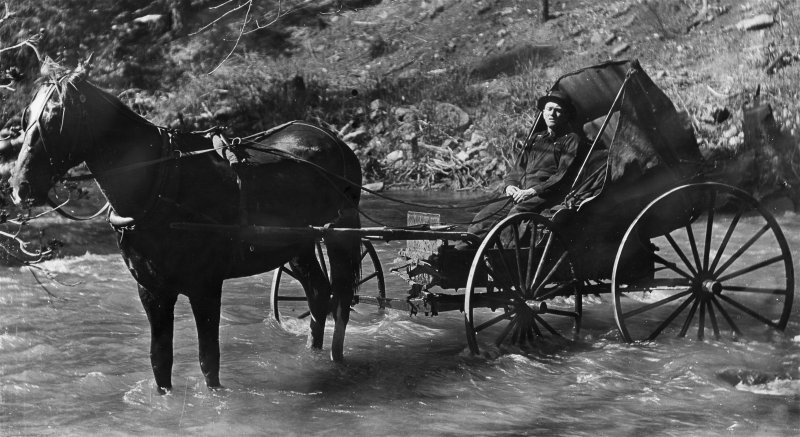
      Mama was so surprised when Papa met us at the train with a team of horses and a two-seated buggy with a roof - they called them Democrats. We know them as surreys only I don't remember 'a fringe around the top.' The trip of 70 miles from Morris to our farm which normally took 4 days by oxen, was only 2 days and we only camped out one night. My uncle was a very excited young man and I suppose in his heart hoped he would never leave this adventurous life. Mama brought her sewing machine back with us and boxes of supplies. I'm sure she was happy to be back with Papa and looked forward to seeing her home. Papa had fixed the house over and it was more than she had hoped for.

      We had a brand new little colt and I don't think I can remember, I was only two, but they say that colt followed me wherever I went in the yard. One day Mama said it followed me right into the house and Mama had quite a time getting it turned around in our little house and out the door. In the process the colt burnt it's nose on the stove. Mama said she had to be careful when she hung up clothes she washed on the line.  If the colt was around he would chew on the clothes and one time she was cooling some pudding on the table by the open window. He stuck his head in through the window and took a nose full of pudding. He was always a pest when we fed the chickens and one had to be careful and make sure you hooked the door to the feed shed. Eventually it was through his nosiness that he met his death. He managed to unlatch the feed shed door and overate oat feed. And when Papa came up with the work horses to water at a well we had for stock, he drank with the horses and because he had overeaten on the oats - that no one knew about - he just swelled up. Mama said it was just awful and a big loss. This was our first horse and farmers need horses. I don't remember but I must have missed him. I have a picture taken with me on his back and my Papa holding me so I wouldn't fall.

      I don't remember personally, but my uncle said he was my babysitter whenever Mama was in the garden and I had to take a nap, he kind of watched out for me. He said he taught me nursery rhymes and cut out paper dolls and made toys out of milk cases and boxes that matches came in. He helped Grandpa plant the trees he brought from St. Paul and carried water to keep them growing. He slept with Grandpa in his little shack in the bank by the creek and then always came up to our house for breakfast. One day he thought he'd make a bonfire and cook some beans like the cowboys did, but Grandpa discovered him and immediately put out the fire and really scolded him. My uncle wasn't aware of the danger of prairie fires unless they are under tight control and water is near. My uncle never forgot. It was an unhappy young man when September came and he had to return to St. Paul and school - but a much wiser boy, with stories of adventure. I'm sure his school chums and the neighborhood boys could hardly believe him.

      It didn't seem right for Mama and me to go back to St. Paul for the winter. We had a fresh cow that gave rich, creamy milk. Mama could make butter and the chickens were increasing in number, eggs were plentiful, the garden had had plenty of water and there would be ample harvest. Grandpa was planning on returning, but later in the year. He had built a two-room house on his property and felt that it was time Grandma joined him the coming spring. So Papa took my uncle to the railway and he traveled back to St. Paul alone on the pass he used when he came - only now he was alone and the conductor questioned him and he felt he was older than twelve, not knowing that my uncle was only a week short of his 13th birthday and in those days children under twelve were one-half fare. But my uncle was on a railway pass and it was free. My uncle avoided being put off by disappearing into the washroom and locking the door and when the train stopped at the border he remained in the washroom until the train started and was well on the way. When my uncle came out and took his seat, there was a new conductor, the change being made at the border of Canada and the U.S. My uncle was scared, but the new conductor smiled, punched the ticket and told him to have a good trip. It was a welcomed relief and another adventure for a young traveler."

Friday, August 12, 2011

In Her Own Words - Our Home (part 2)

          "It might be interesting to describe out house.  It was one room, I would say about 20 feet square.  The exterior was sod slabs about 2 feet wide and 3 feet long, 2 to 3 inches thick.  These slabs were stacked on top of each other like you stack bricks.  We had a door and window on the south and a window on the east.  The grass roots would begin to grow and as they grew they formed a binding and strengthened the wall.  Then the grass grew and even flowering crocuses and buttercups came through reaching for the sun.  The roof was rafters and a building tar paper laid down, nailed to the rafters and covered with straw and then covered with more tar paper and straw with wires that was laced over the top.  The wire was wound around stones that held the straw down and made the roof more secure when the winds came.  Grandpa had bought windows from his sister's place and the door was one I think Grandpa made, because I remember it was very heavy for me to open. 
          The interior was heavy tar paper, grey in color, fastened to the sod by strips of wooden slats and nailed into the sod.  Mama said it was warm in winter and cool in summer.  Grandpa, when he was a fireman and had spare time between fires, developed skills in cabinet making and interior finishing, making furniture, etc.  In one corner of the room he had built a frame for a double bed.  The spring was make of ropes, the cover was straw put into a canvas type bag and that was the mattress.  Under the bed was a smaller frame that could be pulled out and was my bed.  We called it a trundle bed.  The stove was in the center of the room and the chimney went through the roof.  I don't know how they prevented the straw on the roof from catching fire.  I do know Mama was always afraid of making the fire too hot. 
          The head of the built-in bed frame and a long cupboard with shelves formed a small space behind the stove for supplies, dishes, pots and pans, and canned goods, flour, beans, sugar and whatever else one stores in food.  At the end of this food pantry in the corner was a dry sink where a water pail, basin and a slop pail for the waste and dirty water sat.  Above this sink and along the wall above the window was a shelf where we kept the lanterns and lamps, an old fashioned clock and some books.  There was one medical doctor book, one section was on animal care, a Bible and some other books that must have been important to the grownups.  There were some boxes of bullets and shells that fit the two guns that hung on pegs above the door and were always in readiness for any coyote or even a wolf that might venture too close to our horses or oxen, or chickens.
          Under the shelf and between the window and sink, was  roller towel and a box nailed to the wall with a brush and comb.  Grandpa and Papa had their shaving strap hanging there too.  There was a round table in front of the south window and next to it and in the corner was a couch that Grandpa slept on when he didn't go to his own house in the bank by the creek.  That couch was to be my brother's bed, but it wasn't to be.  The opening in the floor for the trap door was on the other side of the table.  I can remember we had to move the table to open it.  Later on Papa dug it deeper and we had a box to step on so we could reach some of the dried vegetables and meat hanging from the floor boards.  Papa was pleased with that improvement - he said at first he didn't even have a floor, only hard dirt and some boards over the hole.  So it was great to have a wooden floor in our house when we came.  Mama hung a curtain in front of the bed and I can remember when I took a nap, Mama pulled the curtain and I pretended I was in a cave.  It was quite dark and sometimes I played on the bed with my clothespin dolls.

          Grandpa, with the help of his nephews, had dug a well on his property and it was very good spring water.  So we got our water from Grandpa's well but we had to haul it.  Grandpa's was about a half mile from our house and we had two big barrels and every week Papa would hitch the team of horses up to what we called a stone boat.  It was wooden planks nailed on two runners about 4 x 6 feet in size.  The barrels would ride on the planks and it took careful steering and control of a team to pull, but Papa never spilled the water.  We could never waste water and when it rained Mama would get all the pails and kettles to catch every drop she could.  Water was a precious commodity.
          Grandpa and Papa built a shelter of sod for the horses and oxen and attached a small shed to this to store feed for the chickens and a space for the chickens to roost and lay their eggs.  Papa and Grandpa and Papa's cousins helped each other in plowing and working up the ground so they could plant wheat and rye and oats and they broke a piece of ground for Mama to make a garden.  She planted potatoes and turnips, beets and another root vegetable called mangelsHymers Glewwe's memoirs of childhood in Saskatchewan 1910-1918.)

In Her Own Words - Our Home

          "This account is recorded from what I had been told, from pictures, and from my childhood memories."   Chapter 2 of Ethel Hymers Glewwe's memoirs.

          "Mama said when she saw our house and entered the door, she wanted to turn and run.  She couldn't ever accept this huge block of sod as her house.  But Grandpa was there to greet them and he was so glad to see her and inside it was just as homelike as Grandpa could make it.  He had a table set and even a bunch of prairie roses - the setting sun shone through a window and she realized that Grandpa had tried to make the room as comfortable as possible.  He had been waiting so long for Papa and his family to return.  It was hard for him to hear the news of his first grandson's death...and realize that some of his dreams now would not come to pass.  Grandpa had fresh bread, but when Mother unpacked some of her foodstuff and eggs and cans of vegetables, fruit and jam - it was a feast for kings.

          Pioneering is a life style that is so totally different than normal traditional living and Mama was soon to experience it.  I remember Mama telling about an incident soon after she arrived.  She had asked Grandpa what he did for meat and shortening and Grandpa raised a rug from the floor and opened a trap door.  Getting on his hands and knees and reaching down into the darkness of the hole, he pulled up a slab of what is called sow-belly.  It is the fat with streaks of meat, cut from the underside of a pig's carcass and cured with salt.  At your butchershop it is called salt pork.  This particular piece was green with mold and Mama couldn't believe that Grandpa would consider using it for food.  Surely he didn't expect her to eat it!  But Grandpa just scraped back the mold and sliced off some pork - it was Mama's first lesson in preparing sow-belly.
          This summer was difficult.  We had no fresh vegetables, the seeds that Grandpa planted did not really produce very much.  We had three hens who had hatched out a few chickens, but we had to keep them for eggs and chickens don't always lay every day.  It takes about four months before young chicks are grown enough to be eaten and then one would only use the roosters and that would take time to select the best rooster for breeding and those that were not.  We had canned milk and occasionally some of the neighbor bachelors would bring some butter and fresh milk in exchange for bread that Mama baked.  Sometimes Mama would cut their hair or wash and mend their clothes - Mama was the only woman around the first two years we lived there.  Papa and Grandpa would go hunting and then we would have prairie chicken or wild turkey, sometimes rabbit or some of the men shot antelope and then everyone shared in a roast and we could make soup.  Mama said the wild meat was always tough and she never liked it much, but she learned how to cook it and cure it with salt."

Found - Pictures of the Hymers men

Yesterday I was talking with the Lois, daughter of Ethel Glewwe, and she gave me access to pictures to include in with the memiors of Ethel and growing up in Saskatchewan.  I've posted a few here and have also gone back and posted them into previous entries on this blog.


Wedding of Caroline "Lena" Marie Nascher and Francis Rankin Hymers
September 26, 1905
St. Paul, Minnesota 


Three generations of Hymers men

John George Hymers (1859 - 1940)
Frank Rankin Hymers (1885 - 1918)
Lloyd Alvin Hymers (1906 - 1910)

Thursday, August 11, 2011

In Her Own Words, cont........(2)

The continuation of Ethel Hymers Glewwe's memoirs of moving to Saskatchewan in 1911.

          "Finally on the last day of this seemingly endless ride, Papa would say it is just over the ridge and then we would be over the ridge and there would be another ridge, and then it was there.  Mama said she knew as soon as she saw a field of green wheat swaying in the breeze like the waves of a green sea that she was home.  Papa stopped the oxen and they sat there and drank in the beauty of the vast country.  Mama said she forgot all the discomfort, the anxiety and the loneliness and the longing for those whom she left behind, and just fell in love with this new life.  This was a new beginning and from that day on she never regretted her decision in becoming a pioneer woman.  After all, her mother was also a pioneer when she left her homeland across the ocean, never to return.  With Papa beside her she could meet whatever was ahead.  As I grew up I looked over that same green field of waving wheat many times."

Wednesday, August 10, 2011

In her own words, cont.........

Ethel Glewwe (1910-1986) memoirs writing about her life on the Saskatchewan prairie.  This chapter details her move to Canada in the spring of 1911.

        "It was at this time that a tragic event happened - my brother became seriously ill.  The doctors couldn't agree as to what ailed him and he gradually weakened and died - he had an intestinal blockage.  He died just two weeks before we were to leave for Canada.*  We had no way of notifying my father and he couldn't be reached before he would come to meet us at the train. 
        My mother and I, with most of our possessions and a year's supply of canned milk for me and other essential baby foods, medicines, etc., left the security of her family and boarded the train for the unknown.  Plans had been made to go to my grandfather's sister Sarah's at Summerberry, Saskatchewan, about one hundred miles north of our farm, where we were to meet my father.
        My mother had never met these relatives, but she became very close to Sarah and her daughter, Maud.  I suppose I was a welcome addition - a baby always wins the hearts of young girls and Sarah had three daughters and four sons.  They were all at home except Bud and Bert, who were out in the same new territory my father and grandfather had laid claim to.  The many stories and experiences my mother had in adapting to pioneer life and just preparing for the long trip to the new country we were to call home would be a chapter in itself.

          Eventually my father came and we were saddened again over the telling of my brother's death.  My father, they say, just cradled me in his arms and said I'd be his daughter and son.  There was no time to waste.  Papa had to get his wagon ready and buy supplies.  We had to carry our drinking water.  Papa bought lumber to finish the interior of our house - we had three setting hens in a crate and eggs.  Papa's Uncle Jim gave him two horses and we had oxen to pull the wagon, with the horses tied on the back.
          I was told the wagon was like a covered wagon, but at night we would sleep under the wagon and Papa would take some of the lumber and some canvas and put it against the wheels to break the night's cool air.  With straw and horse blankets we would keep warm.  Mama told me one night it rained and rained but we kept dry under the wagon.  That must have been difficult with a baby.  I wonder what happened to the things in the wagon - maybe Papa had enough canvas to cover the flour, sugar and other perishables.  Mama had the chickens with us under the wagon. 


          I don't recall how long Mama said it took but usually with oxen one made about 10 miles from sun up to sun down.  I'm sure Mama was tired of it all.  I was probably fussy - after four or five days I wonder if I even got a bath.  Mama told me that at night Papa would light two lanterns and keep them burning so the coyotes wouldn't come too close.  Mama said she could see their eyes shining in the dark, but they never came real close, just whimpered and cried almost like me.  I wonder if Mama got any sleep - I'm sure Papa had to hold her in his arms to chase away her fears."

*Lloyd Alvin Hymers (1906-1910)

Ethel Hymers Glewwe - In her own words

Ethel wrote her memories down when her daughter, Lois started working on a family history book back in the 1990's.  What follows are some excerpts from her writings.

Caroline Nascher
      "My father's parents, John and Rozella, attended school, grew up in the same neighborhood and it was quite natural that my grandmother should be courted by the neighbor's son who was my grandmother's stepmother's brother, or my grandmother's step-uncle.  And so they were married and moved to St. Paul, Minnesota.  My grandfather, John was a fireman on St. Paul's west side and was in charge of the horse drawn wagon.  The family lived at 50 W. Belvidere and my father, Frank, was born on December 6, 1885.  During his school years he worked as a lamplighter along the Mississippi River, and after graduating from Humboldt High School, began working for the Ferguson Gordon Cap Company.  At the same factory was a young girl who sewed caps, named Caroline Nascher.


        In 1905 he married my mother and in 1906 my brother Lloyd was born.  In 1908 twin boys were born prematurely and lived only a few hours, and on June 7, 1910, I was born. 


        In 1908 my grandfather was urged to join his sister Sarah and her husband Jim in Saskatchewan, Canada, where parcels of land were being opened up for homesteading and there seemed to be a great future in wheat farming.  Two of John's daughters, Bertha and Maymie, were married and living in St. Paul.  Ethel, Cora, and a young son, Allen, were still at home.  His years of service in the fire department were beginning to weigh on him and horses were on their way out as power for fire vehicles, so he retired from the department, left his family in St. Paul, and went to Canada.  With his nephews he staked out land some hundred miles south of his sister's spread and returned to St. Paul.  He convinced my father of the wonderful opportunity to be in on a great future, breaking and cultivating virgin prairie for growing hard kernel wheat.  Employment in St. Paul was not that secure and it was a chance to better one's circumstances, so my father decided to join his cousins.

        Grandpa and Papa left in October, 1909, and laid a claim by living on the land in a sod, one-room shack, dug out of a bank and bordering a creek, for six months.  They then returned to St. Paul to tell the family and buy supplies.  My brother, Lloyd, then 4 years old, was a strong healthy boy and my father's pride and hope in the future.  Our father, after much preparation, left in August, 1910, to return to Canada for the winter and build a house for us.  We would come in the spring after he had planted the wheat on the newly turned sod with the help of his cousins and father. 

In those months while Grandpa and Papa were gone, my mother, brother, and I lived with Grandma Rozella and Papa's sisters and brother until the spring of 1911.  Communication with Papa was difficult, almost impossible.  Our spread was seventy miles from a town and railway, a four to five day trip by oxen and wagon."

Ethel Hymers Glewwe - As a bride

" One night in the summer of 1927, Ethel was at a social event at the (Riverview Baptist) church with one of the young men.  As the group prepared to go home, Ethel's date asked Reuben Glewwe if he would give them a ride home.  Reuben agreed and Ethel and the young man climbed in the back seat of Reuben's car.  Reuben was also with a girl, but during the trip, his eyes kept meeting Ethel's in the rear view mirror.  Romance was born and Reuben and Ethel soon began dating.  They became engaged on December 10, 1927.

In later years, the family often joked about Reuben's sisters' reactions to the engagement.  Reuben had always received more of his sisters' attention than he ever wanted and when he announced that he was going to marry that 'new girl', Ethel Hymers, the Glewwe girls were shocked.  No one knew anything about her or her family and she was only seventeen!  Still, Reuben had made up his mind and he and Ethel were married at Riverview Baptist Church on Ethel's eighteenth birthday, June 7, 1928.  The reception was held at her mother and stepfather's home in St. Paul.

Their honeymoon was not spent at some romantic vacation spot.  Instead, Ethel insisted that Reuben take her back to the prairies of Saskatchewan and the hometown of Kincaid where she had such strong memories of her childhood.  It was over eight hundred miles one way in Reuben's 1928 Whippet.  The trip generated enough stories to keep the family amused for years to come."

The Glewwe Family History  by Lois Glewwe, Dec 1999, page 269

Ethel Hymers Glewwe, cont.

"Our Social Circle"          
        by Lu Jarvis

     Rollie Glewwe, whose mother, Ethel (Mrs. Reuben) Glewwe was chosen as one of Suburban Newspaper's "Personalities of the Year" last week, sent her a dozen gorgeous American beauty roses the next day.

     "If you're going to be 'Queen for a Day', we might as well do it up right", was Rollie's laughing comment.

     (His thoughtfulness gets him our own nomination as No. 1 Son of the year.)

     Reason we happened to know about the roses is that we glimpsed them on the dining table when we returned the old pictures we'd "filched" from some of the Glewwes to go with the story.  Ethel Glewwe, ..... was unaware of the purpose of our interview with her last week.

South St Paul Reporter Booster, Wednesday, Jan. 13, 1965 page 11